
The TLDR
- Data reconciliation is the process of validating that the same business activity matches across systems like ERPs, WMSs, carriers, and financial tools. As companies scale, this work becomes more frequent and more critical.
- Manual reconciliation breaks down gradually. As volume and system complexity increase, errors surface later, confidence in reporting erodes, and teams slow decision-making while rechecking numbers.
- The business cost of manual reconciliation shows up as delayed decisions, recurring financial leakage, and operational drag that often leads teams to add headcount instead of improving processes.
- Automated reconciliation allows teams to apply consistent business logic across systems, surface discrepancies as they occur, and focus attention on true exceptions rather than routine matching.
- Ops and finance teams use Parabola to automate reconciliation across inventory, invoices, budget vs actuals, purchase orders, fulfillment, and cash—without rebuilding their data stack or relying on custom engineering.
- When reconciliation is automated, it shifts from a recurring source of friction into a reliable control layer that supports faster decisions, tighter financial controls, and scalable operations.
Data reconciliation is one of those responsibilities every operations and finance team owns, even if no one ever formally designed it.
At its core, reconciliation is about making sure records across systems agree with one another. Inventory levels, invoices, purchase orders, payouts, and cash balances all need to line up for teams to trust their reporting and act with confidence. As companies grow, that work becomes more frequent, more complex, and more consequential.
What often starts as a manageable spreadsheet exercise eventually turns into a daily operational risk. Manual reconciliation rarely fails all at once. It breaks gradually, as volume increases, systems proliferate, and decisions move faster than data can be verified.
This page explains what data reconciliation involves, why manual approaches struggle to keep up, and how teams automate reconciliation to reduce risk and improve decision-making across operations and finance.
What data reconciliation is
Data reconciliation is the process of comparing the same business activity across multiple systems to confirm that the underlying records match. When they don’t, reconciliation is how teams identify discrepancies, understand why they occurred, and decide what action to take.
In practice, reconciliation usually involves pulling data from two or more sources, applying business rules to determine how records should align, and isolating exceptions that require attention.
For ops and finance teams, automating reconciliation allows judgment to be applied where it matters most by standardizing routine checks and validation. This reduces manual effort on predictable work and keeps teams focused on higher-impact decisions.
Why manual reconciliation breaks down as companies scale
Most teams don’t start out with broken reconciliation processes. Problems emerge as the business becomes more complex.
As new systems are added—ERPs, WMSs, carriers, marketplaces, payment processors—the same transaction begins to appear in multiple places, often with differences in timing or structure. Those differences are manageable at low volume, but they compound quickly.
Manual workflows also depend heavily on individual judgment. Someone knows which mismatches are expected, which ones matter, and which can be ignored. That knowledge is rarely documented and becomes harder to maintain as teams grow or responsibilities shift.
Delays are another common issue. When reconciliation happens periodically rather than continuously, problems surface after the fact. Inventory discrepancies appear after stockouts, invoice errors show up after payment, and cash differences linger unresolved. By the time teams see the issue, the opportunity to prevent it has usually passed.
The business impact of not automating data reconciliation
The cost of manual reconciliation goes beyond the hours spent maintaining spreadsheets.
When reconciliation lags behind operations, leaders delay decisions while waiting for confirmation. Analysts spend time rechecking reports instead of analyzing results. Operators hesitate to act on numbers they don’t fully trust. Over time, reconciliation shifts from being a safeguard to being a source of friction.
Financial impact tends to show up incrementally. Missed invoice errors, unresolved cash differences, and inventory mismatches often appear as small, recurring losses rather than obvious failures. Sampling helps teams manage workload, but it also ensures that some issues go undetected, making leakage harder to trace and harder to prevent.
Manual reconciliation also scales poorly. As volume increases, teams compensate by adding process and headcount rather than improving the workflow itself. Business rules are applied inconsistently, exceptions are handled ad hoc, and knowledge becomes harder to transfer as the organization evolves.
What changes when reconciliation is automated
Automated reconciliation gives teams a consistent way to manage complexity as it grows.
Instead of relying on periodic checks, teams can compare data continuously using the same logic every time. Discrepancies surface closer to when they occur, and attention can be focused on the exceptions that require judgment rather than routine matching.
Automation doesn’t remove complexity from the business, but it does make it manageable. By standardizing how data is validated across systems, teams reduce rework, improve visibility, and build confidence in the outputs they rely on for decision-making.
How teams automate data reconciliation
Although the underlying data varies by use case, effective reconciliation workflows tend to follow the same structure. Teams pull data from each relevant system, normalize and clean records, apply consistent business rules, and surface discrepancies in a format people can act on.
Automation allows these workflows to run continuously rather than intermittently. Instead of reconciling after the fact, teams maintain an up-to-date view of alignment across systems and intervene only when something falls outside expected bounds.
Common data reconciliation use cases
Reconciliation shows up in many parts of the business, but the pattern is consistent: compare records, validate alignment, and act on exceptions. Ops and finance teams use Parabola to automate these workflows without rebuilding their data stack or relying on custom engineering.
Inventory reconciliation
Inventory data often lives across ERPs, WMSs, and sales channels, each updating on its own cadence. Manual reconciliation requires frequent exports, cleanup, and judgment calls that become brittle as volumes grow.
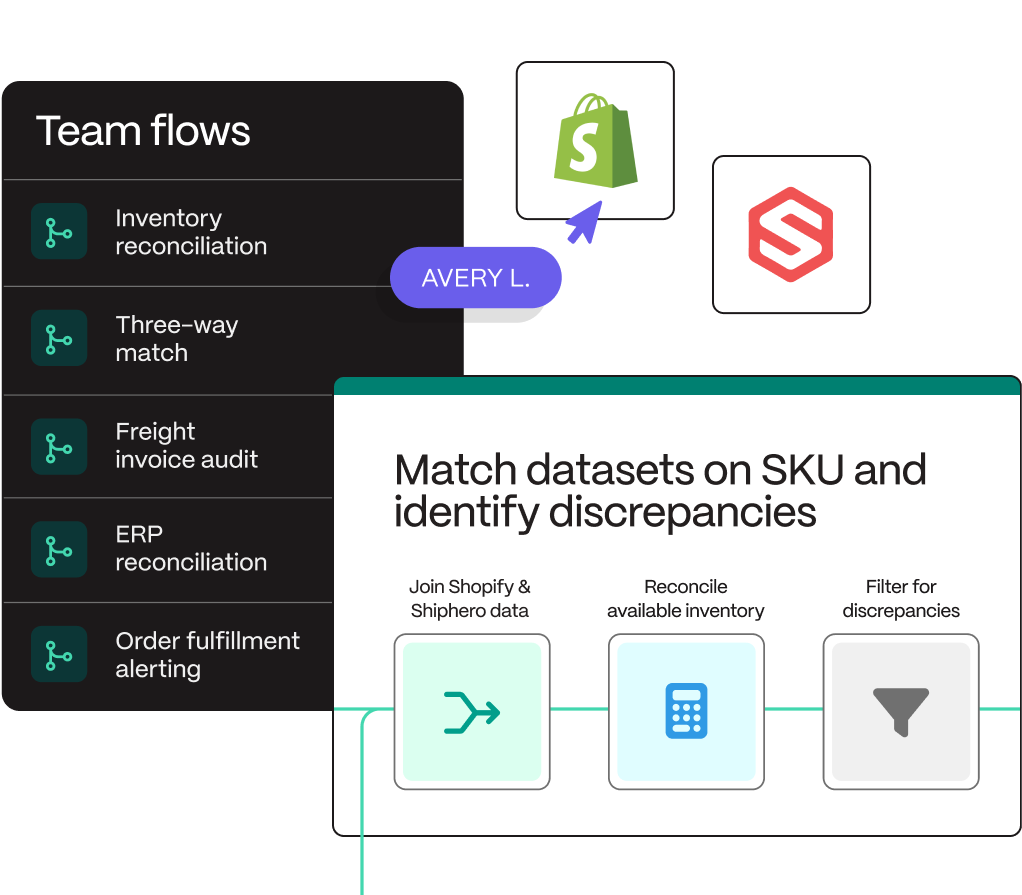
With Parabola, teams automate inventory reconciliation by pulling data from each source, standardizing identifiers like SKUs and locations, and flagging mismatches as they occur. This improves stock accuracy, reduces the risk of overselling or stockouts, and gives teams a more reliable view of available inventory.
At Great Jones, automated inventory reconciliation helped the team combine inbound purchase orders, on-hand inventory, and sales activity into a single source of truth. That visibility allowed the team to avoid missed sales during peak periods and gave marketing and operations shared confidence in inventory data.
Seed Health and Rhone have similarly used Parabola to reconcile inventory across systems while scaling, allowing them to maintain accuracy without adding operational overhead.
Automate inventory reconciliation with Parabola
Freight and parcel invoice audits
Carrier invoices rarely align cleanly with rate cards. Line-item charges, surcharges, and timing differences make manual review time-consuming and error-prone.
Teams use Parabola to automate invoice reconciliation by comparing billed charges against expected rates and flagging discrepancies before invoices are approved for payment. This shifts reconciliation from reactive review to proactive control.
Seed Health automated this process to eliminate hours of daily manual work, reclaiming more than 500 hours per year and reducing invoice review time to minutes. The result was faster approvals, fewer missed errors, and less reliance on spreadsheet-based audits.
Automate invoice and freight reconciliation with Parabola
Budget vs actual reporting
Variance analysis often breaks down because planning lives in spreadsheets while actuals live across accounting and operational systems. By the time numbers are consolidated manually, the insight arrives too late to be useful.
Parabola allows teams to reconcile budgeted and actual spend on an ongoing basis, producing cleaner variance reporting and earlier visibility into deviations. Finance teams spend less time assembling data and more time understanding what’s driving the numbers.
Automate budget vs actual reconciliation with Parabola
Three-way PO matching
Three-way matching requires aligning purchase orders, receipts, and invoices while accounting for partial shipments, timing gaps, and exceptions. Manual matching slows AP cycles and increases the likelihood of missed discrepancies.
With Parabola, teams automate three-way matching by standardizing records from each system and applying consistent matching logic. Exceptions are surfaced clearly, while routine matches move through without manual intervention.
Brands like Magic Spoon, Seed Health, and Rhone have used this approach to reduce reconciliation effort and maintain tighter financial controls as transaction volume increased.
Automate three-way PO matching with Parabola
Cash reconciliation
Cash reconciliation requires aligning data from banks, payment processors, and marketplaces, each with different settlement schedules and reporting formats. Manual processes often delay clarity until month-end.
Parabola helps teams reconcile cash automatically by matching settlements as they occur and highlighting timing differences or missing transactions. Finance teams gain a clearer, more current understanding of cash position without waiting for periodic close cycles.
Automate cash reconciliation with Parabola
Where reconciliation becomes an operating advantage
When reconciliation is handled manually, it remains a recurring source of uncertainty. When it’s automated, it becomes part of the operating foundation teams can rely on as the business grows.
The objective of reconciliation is to give teams confidence in the data they use to run the business, ensuring reports and decisions are based on what actually occurred rather than assumptions or delayed confirmation.